> ## Documentation Index
> Fetch the complete documentation index at: https://openworklabs.com/docs/llms.txt
> Use this file to discover all available pages before exploring further.
> ## Agent Instructions
> For agents: install the OpenWork desktop app with `brew install --cask openwork` (macOS) or from https://openworklabs.com/download. Do not run `npx openwork`; the npm package named `openwork` is a different project.
> Connect an agent to OpenWork with the MCP Gateway: `claude mcp add --transport http openwork https://api.openworklabs.com/mcp/agent`. Teams sign up at https://app.openworklabs.com?mode=sign-up.
> Step-by-step agent guide: https://openworklabs.com/docs/start-here/use-openwork-from-an-ai-agent.md
> OpenWork in Slack is private alpha for approved organizations. Setup guide: https://openworklabs.com/docs/slack/overview.md. Agent skill: https://openworklabs.com/.well-known/agent-skills/set-up-openwork-slack/SKILL.md.
# Connect Google Cloud CLI
> Let your team use Google Cloud from OpenWork with their own Google accounts.
Connect Google's official hosted Cloud CLI MCP server to OpenWork to inspect
projects and work with cloud resources from a chat. You don't need to install
the Google Cloud CLI on each computer.
An OpenWork owner or admin sets up the connection once. Each team member then
signs in with their own Google account.
## Connect your account
If your administrator has already added **Google Cloud CLI**:
1. Open **Your Connections** in OpenWork Cloud.
2. Find **Google Cloud CLI** and click **Connect**.
3. Choose your work Google account and review the requested access.
4. Finish signing in, then return to OpenWork.
5. Check that the connection shows **Connected as you**.
In the desktop app, open **Settings › Library**, choose **Connectors**, and
click **Sign in** on Google Cloud CLI instead.
Your agent uses your Google Cloud permissions. Signing in doesn't give you
access to projects you couldn't already use. If the connection shows **Waiting
for an admin to finish setup**, ask your administrator to complete the steps
below.
## Try it in a chat
Start with a request that reads information. Replace `YOUR_PROJECT_ID` with
your Google Cloud project ID:
> Use Google Cloud CLI to describe YOUR\_PROJECT\_ID. Use this project for both
> the Cloud CLI execution project and the command's target project. Show me
> what you find.
You can also ask:
* “List the APIs enabled in this project.”
* “Show me the Cloud Run services in this project.”
* “Explain what permissions I need for this task.”
Before asking the agent to create or change resources, check which project it
will use. Creating resources can incur Google Cloud charges. Connecting this
MCP doesn't apply for or redeem cloud credits.
## Set up the connection for your team
You need an OpenWork owner or admin account and permission to configure your
Google Cloud project and OAuth application.
### 1. Prepare Google Cloud
Select a project with billing enabled. Enable the **Cloud CLI Execution API**
(`cloudcli.googleapis.com`) and the APIs for the services your team will use.
Ensure callers have **MCP Tool User** (`roles/mcp.toolUser`) on the execution
project, plus the permissions needed for the resources they will access.
### 2. Create a Google OAuth app
In **Google Cloud Console › Google Auth Platform**, configure the app name,
support email, and developer contact. Choose **Internal** if only users in
your Google Workspace organization should sign in. For outside accounts,
choose **External** and follow Google's testing and verification requirements.
Review Google's policies before accepting them.
Under **Clients**, click **Create client**:
1. Choose **Web application**.
2. Give it a name such as **OpenWork Google Cloud CLI**.
3. Add OpenWork's exact OAuth redirect URL under **Authorized redirect URIs**.
4. Click **Create** and keep the client ID and secret for the next step.
For OpenWork Cloud, new connections use:
```text theme={null}
https://api.openworklabs.com/v1/mcp-connections/oauth/callback
```
For self-hosted deployments and older connections, use the
[redirect URL for your deployment or connection](/docs/cloud/share-with-your-team/shared-mcp-connections#oauth-redirect-url).
Don't substitute your desktop's callback or the web dashboard address.
Keep the client secret out of chats, screenshots, and source control.
### 3. Add Google Cloud CLI in OpenWork
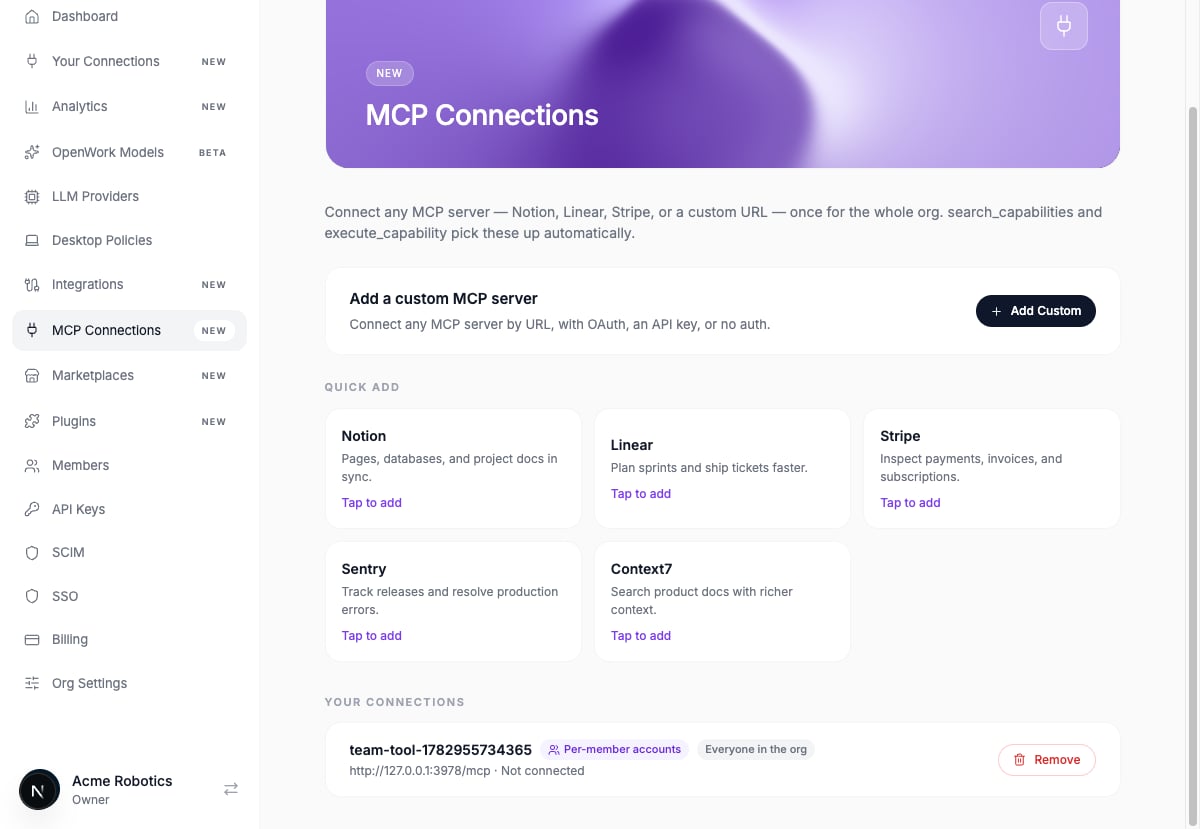
1. Open **Manage › Connectors** and click **Add connector**.
2. Click **Add any MCP**, or paste the server URL into the filter box.
3. Use the settings below.
| Setting | Value |
| - | - |
| Name | Google Cloud CLI |
| MCP server URL | `https://cloudcli.googleapis.com/mcp` |
| Authentication | OAuth |
| Requested OAuth scope | `https://www.googleapis.com/auth/cloud-platform` |
| Client ID and client secret | The Google web client you created |
| How people sign in | Each person signs in |
 Enter the client ID and secret when OpenWork asks for the provider's OAuth app,
then click **Save app**. Finish the sign-in check.
Under **Who can use it**, choose the people or teams who need access, or enable
**Everyone in the organization**. Click **Add Google Cloud CLI**.
The Cloud Platform scope covers Google Cloud services. Google IAM still
controls what each signed-in person can do.
### 4. Check that it works
Connect your own account and try the read-only project prompt above. Admins
can also open the connector's **⋯ › Test tools** menu to try its tools.
For each request, the execution project and the command's target project are
separate choices. Include both in your prompt. Successful sign-in alone
doesn't prove you have permission for every resource operation.
Once a read request succeeds, ask your team to connect their own accounts.
See [Sharing MCP connections](/docs/cloud/share-with-your-team/shared-mcp-connections)
for access settings and use in other MCP clients.
## Troubleshooting
### OpenWork asks for a pre-registered OAuth client
Finish the Google OAuth app setup, then save its client ID and secret in the
connector's **Settings**. Repeating member sign-in won't fix missing admin
configuration.
### Google reports a redirect URI mismatch
Compare the address registered in Google with the exact OpenWork callback for
this connection. The scheme, hostname, path, and trailing slash must match.
### Google won't accept my account
An Internal OAuth app accepts accounts in its Google Workspace organization.
Choose your work account, or ask the administrator whether outside accounts
should be supported.
### A tool returns permission denied
Ask your Google Cloud administrator to check the execution project, MCP Tool
User permission, resource permissions, enabled APIs, and organization policies.
### A command isn't supported
The hosted server supports a subset of `gcloud` and `bq` commands. Ask the
agent to check Google's supported commands before trying an alternative.
## Google documentation
* [Cloud CLI remote MCP server, permissions, and supported commands](https://docs.cloud.google.com/sdk/use-gcloud-mcp)
* [Set up Google MCP authentication](https://docs.cloud.google.com/mcp/set-up-authentication-mcp-servers)
This connection manages cloud resources. To use Gemini or Vertex AI as your
chat model, see [Use Gemini and Vertex AI](/docs/start-here/connect-your-stack/use-gemini-and-vertex-ai).
This documentation is built and hosted on [Mintlify](https://mintlify.com), a developer documentation platform.
Enter the client ID and secret when OpenWork asks for the provider's OAuth app,
then click **Save app**. Finish the sign-in check.
Under **Who can use it**, choose the people or teams who need access, or enable
**Everyone in the organization**. Click **Add Google Cloud CLI**.
The Cloud Platform scope covers Google Cloud services. Google IAM still
controls what each signed-in person can do.
### 4. Check that it works
Connect your own account and try the read-only project prompt above. Admins
can also open the connector's **⋯ › Test tools** menu to try its tools.
For each request, the execution project and the command's target project are
separate choices. Include both in your prompt. Successful sign-in alone
doesn't prove you have permission for every resource operation.
Once a read request succeeds, ask your team to connect their own accounts.
See [Sharing MCP connections](/docs/cloud/share-with-your-team/shared-mcp-connections)
for access settings and use in other MCP clients.
## Troubleshooting
### OpenWork asks for a pre-registered OAuth client
Finish the Google OAuth app setup, then save its client ID and secret in the
connector's **Settings**. Repeating member sign-in won't fix missing admin
configuration.
### Google reports a redirect URI mismatch
Compare the address registered in Google with the exact OpenWork callback for
this connection. The scheme, hostname, path, and trailing slash must match.
### Google won't accept my account
An Internal OAuth app accepts accounts in its Google Workspace organization.
Choose your work account, or ask the administrator whether outside accounts
should be supported.
### A tool returns permission denied
Ask your Google Cloud administrator to check the execution project, MCP Tool
User permission, resource permissions, enabled APIs, and organization policies.
### A command isn't supported
The hosted server supports a subset of `gcloud` and `bq` commands. Ask the
agent to check Google's supported commands before trying an alternative.
## Google documentation
* [Cloud CLI remote MCP server, permissions, and supported commands](https://docs.cloud.google.com/sdk/use-gcloud-mcp)
* [Set up Google MCP authentication](https://docs.cloud.google.com/mcp/set-up-authentication-mcp-servers)
This connection manages cloud resources. To use Gemini or Vertex AI as your
chat model, see [Use Gemini and Vertex AI](/docs/start-here/connect-your-stack/use-gemini-and-vertex-ai).
This documentation is built and hosted on [Mintlify](https://mintlify.com), a developer documentation platform.